AI Agents vs. Traditional Automation: What Your Business Needs
Why rule-based bots fall short and how autonomous AI agents are reshaping business processes.
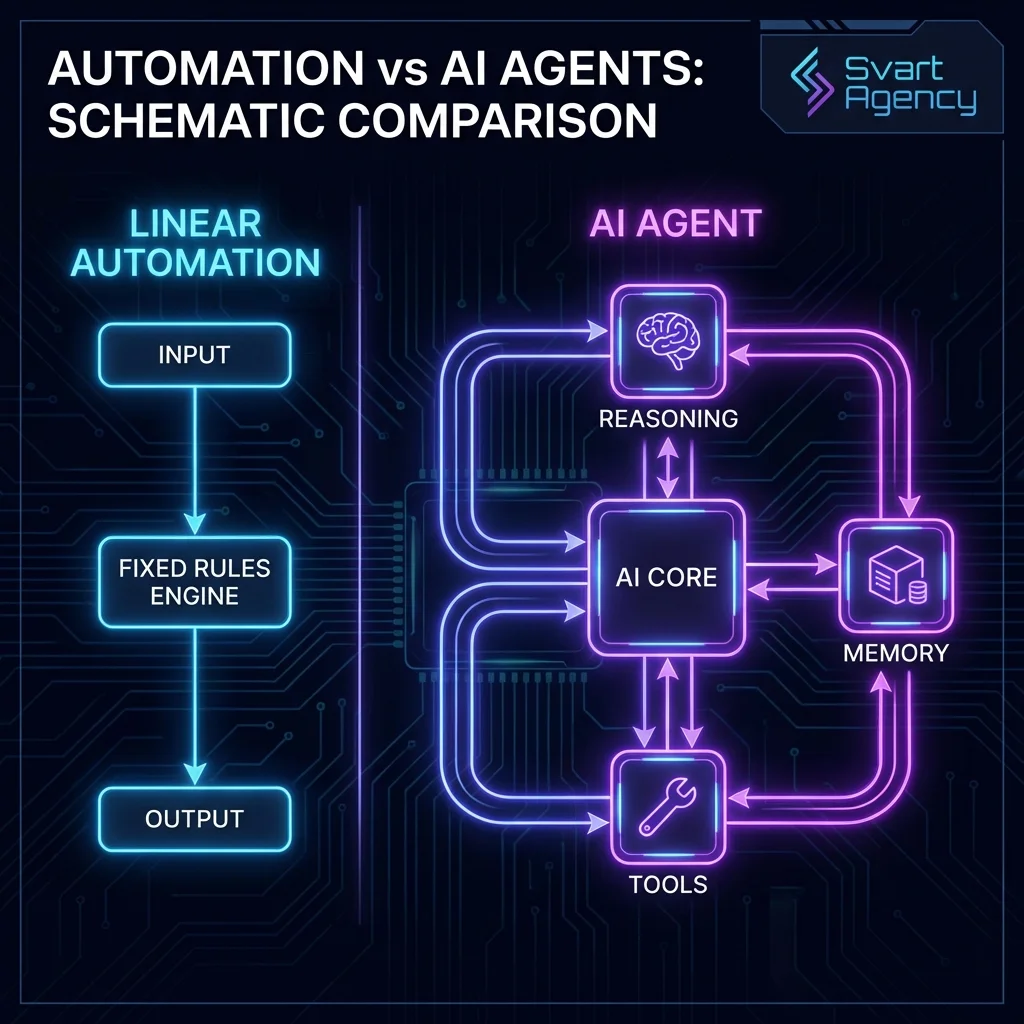
We are experiencing a fundamental shift in how software creates value. For the last decade, "Automation" meant writing rigid rules: 'If X, do Y.'
This works perfectly for predictable tasks. But business is variable. Data is complex. Customers are unpredictable.
This is where AI Agents come in. Unlike traditional automation scripts that follow a track, Agents use LLMs (Large Language Models) as a reasoning engine to manage ambiguity, make decisions and execute complex workflows without constant human supervision.
The Old Way: Linear Automation
Traditional automation (RPA, Zapier, simple scripts) is fragile. It depends on ideal scenarios.
- If an API response format changes -> It breaks.
- If a customer asks an unexpected question -> It breaks.
- If a file is missing -> It breaks.
It's like a train on rails. Fast and efficient, but can only go where the rails are laid. A single obstacle on the track brings the entire operation to a standstill.
The New Way: Agentic Transformation
AI Agents are not trains; they are off-road vehicles. They don't just follow instructions; they understand the goal.
An Agent has:
- Reasoning (Brain): Plans how to solve a problem.
- Memory (Context): Remembers past interactions and data.
- Tools (Hands): Can browse the web, query databases, send emails or run code.
When an Agent encounters an error, it doesn't crash. It reads the error message, 'thinks' of a solution and tries again. This self-healing capability creates a massive ROI difference.
Technical Depth: LangGraph & Architecture
At Svart Agency, we don't just wrap ChatGPT. We build stateful multi-agent systems using LangGraph and LangChain.
Why LangGraph? Because complex enterprise processes are not simple chains (A -> B -> C). They are graphs with loops, conditions and parallel states.
The Agentic Loop
1. Observe: Read user request or system state.
2. Think: Consult the LLM (Reasoning Engine).
3. Act: Trigger a specific tool (e.g. 'CRMSearchTool')
4. Evaluate: Check tool output.
5. Loop: Decide if the task is complete or if another step is needed.
This loop allows us to build systems capable of tasks like 'Research 5 competitors, summarize their pricing and draft a strategy report', a task impossible with traditional automation.
Strategic Business Value
Cost Reduction
Replace manual processes with intelligent automation
Scalability
Handle thousands of concurrent tasks without increasing headcount
Speed
Execute multi-step research and analysis tasks in minutes
Resilience
Self-healing systems that adapt to unexpected inputs
Ready to build the workforce of the future?
Stop building chatbots. Start building agents. We design custom AI solutions that do real business work.